Why Flat-Pack Furniture Takes Longer Than the Box Says
The estimate printed on the box assumes a clear floor, every screw present, and nobody stopping to fix a mistake. Real assembly rarely works that way.
October 20, 2026 · 4 min read
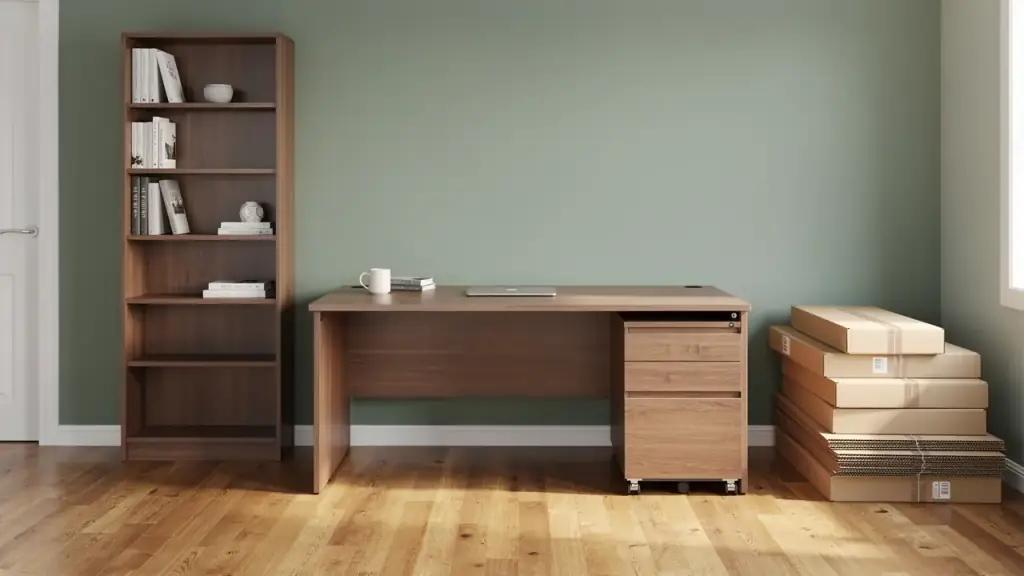
The side of the box says about ninety minutes. Three hours later you are on the floor holding a panel the wrong way round and looking at a bag of hardware that seems to have an extra bolt. This is not a sign you are bad at it. Flat-pack furniture is designed to ship cheaply and to be assembled by anyone, and those two goals leave a lot of the real work to you. Knowing where the time goes makes the job faster and the result sturdier.
Where the extra time goes
The estimate on the box assumes the best case: a clear floor, every part present, instructions that match what is in front of you, and no mistakes. It rarely counts unpacking, sorting, and checking. A desk can arrive with dozens of pieces, and several look almost identical. Panels are often left and right versions of each other, with holes drilled in slightly different places. Putting one on the wrong side is easy, and you usually find out three steps later.
- Unboxing and sorting: laying out panels, counting hardware against the parts list, and keeping the screw types apart.
- Reading the steps: the diagrams are wordless, and a small arrow or a tiny difference in a drawing decides which way a panel faces.
- Backtracking: a wrong-way panel has to come off, and the cam locks and dowels that went in are not always happy to be removed.
- Heavy lifting: tall bookcases and large desktops often need two people, and waiting for the second pair of hands is time too.
- Finishing: standing it up, leveling it, adding the back panel, and attaching the doors or drawers so they close properly.
Hardware that fights back
Much flat-pack furniture is made of particleboard or fiberboard, which grips screws less forgivingly than solid wood. Drive a screw in too hard, or back it out and re-drive it a few times, and the hole strips. A stripped hole holds nothing. The same goes for cam locks, which turn to pull a bolt tight and can crack a panel edge if they are forced. The practical rule is to tighten until snug, then stop. Tightening everything fully at every step can also leave you unable to line up the next piece, so most assemblies go better with the early connections loose until the frame is together.
What “squared up” means
A box-shaped piece of furniture is square when every corner is a right angle. It sounds obvious, but flat-pack frames are held together by small fasteners, and a frame with nothing keeping it square will lean into a parallelogram. You can check it with a tape measure by comparing the two diagonals from corner to corner. When the two measurements match, the frame is square. When they differ, push the longer diagonal's corners toward each other until they agree.
That is also why the thin back panel matters. On a bookcase, it looks like cardboard, but once it is nailed or screwed on a square frame, it locks the shape in place. Skipping it, or fastening it to a frame that is already leaning, gives you a piece that wobbles and sticks drawers and doors. Square the frame first, then fix the back panel while it is square.
What “anchored” means
Tall furniture such as bookcases, dressers, and file cabinets can tip forward, especially when drawers are open or shelves are loaded unevenly. Anchoring means fastening the top of the piece to the wall with a strap or bracket, driven into a stud or fitted with a rated wall anchor. Safety organizations commonly recommend anchoring tall pieces, particularly in homes with children, and many manufacturers include the hardware for it. It is worth the extra ten minutes and it is the step most people skip. Office furniture that holds heavy equipment on a shelf deserves the same treatment.
Level matters here too. A floor that slopes slightly can rack a tall frame out of square once it stands up. Shims under a leg, or the adjustable feet many pieces include, take care of it.
Office pieces add their own wrinkles
Desks with cable openings, modesty panels, and adjustable shelving come with more steps than a simple table. Several desks in a small office often arrive at once, and assembling them in a space that is also in use means parts end up in hallways. A good approach is to assemble each piece near where it will sit, assemble the biggest piece first, and leave the shipping boxes in one spot until you are sure nothing is missing. Keep the instructions until the job is fully done, because the last step of a manual often refers to something you did at the start.
Letting someone else do it
Viking Handyman Services lists furniture assembly as efficient assembly of commercial office furniture and residential furniture. The page is at /services/furniture-assembly. The business serves Rutherford, Williamson and Wilson Counties, including Murfreesboro and Smyrna. If you have a stack of boxes waiting, send the list of pieces through /contact or call (615) 476-0089, and mention whether anything needs to be anchored to the wall.
Viking Handyman Services, LLC, (615) 476-0089
Call (615) 476-0089More articles
How to Write a Honey-Do List a Handyman Can Finish in One Visit
The difference between a list that gets finished and one that turns into three trips is mostly in how each line is written.
Mounting a TV on Drywall: What Decides Where It Can Go
The wall you want and the wall that can carry the screen are not always the same wall. Four checks tell you which one you have.